
Both general dentists and oral surgeons place dental implants, and both can do it well. The useful question is not who is allowed to — it is which one is the better fit for your particular case, and how to tell the difference before you commit.
How The Training Differs
A general dentist completes dental school and is licensed to perform a broad range of procedures. Implant placement is not a required part of that education; dentists who place implants add it through continuing education courses, ranging from weekend programs to substantial multi-year curricula. The variation between practitioners is therefore wide.
An oral and maxillofacial surgeon completes dental school and then a hospital-based surgical residency of four to six years devoted to operating on the jaws and face — including bone grafting, sinus procedures, facial trauma, and anesthesia. Dr. Michael Babston completed his residency at the University of Alabama at Birmingham, earned an MD from the UAB School of Medicine in 2014, and served as chief resident of the UAB Oral and Maxillofacial Surgery program.
Cases Where Either Can Work Well
A single implant, in a site with plenty of healthy bone, well away from the sinus and nerve, in a healthy patient, is a well-defined procedure. A general dentist with real implant training and 3D imaging can handle it, and there is an advantage to staying with the practice that knows your mouth.
What to ask in that situation: how many implants they place per year, whether they take a CBCT scan for planning, what sedation they can offer, and what happens if bone turns out to be inadequate once the site is opened.
Cases That Belong With A Surgeon
- Inadequate bone. If the site needs grafting or a sinus lift, that is reconstructive bone surgery — see bone grafting.
- Multiple implants or full-arch restoration. More sites means more anatomy to navigate and longer time under anesthesia.
- Extraction and implant in the same visit. Doable, but it depends on socket integrity and infection status. Our same-day tooth extraction page explains the same-visit approach.
- Active infection or a failing implant. Both need to be resolved surgically before or during placement — see tooth infection treatment.
- Complex medical history. Bisphosphonates, immunosuppression, uncontrolled diabetes, and prior radiation all affect bone healing and change the plan.
- Significant anxiety. Oral surgeons are trained in IV sedation and general anesthesia; see sedation options.
It Is Often Not Either/Or
The most common arrangement is a team one: your general dentist plans the restoration and makes the crown, and an oral surgeon places the implant. You keep your relationship with your dentist and get a specialist for the surgical phase. Referrals in both directions are routine, and we work with dentists across the Mobile area every week.
Questions Worth Asking Anyone
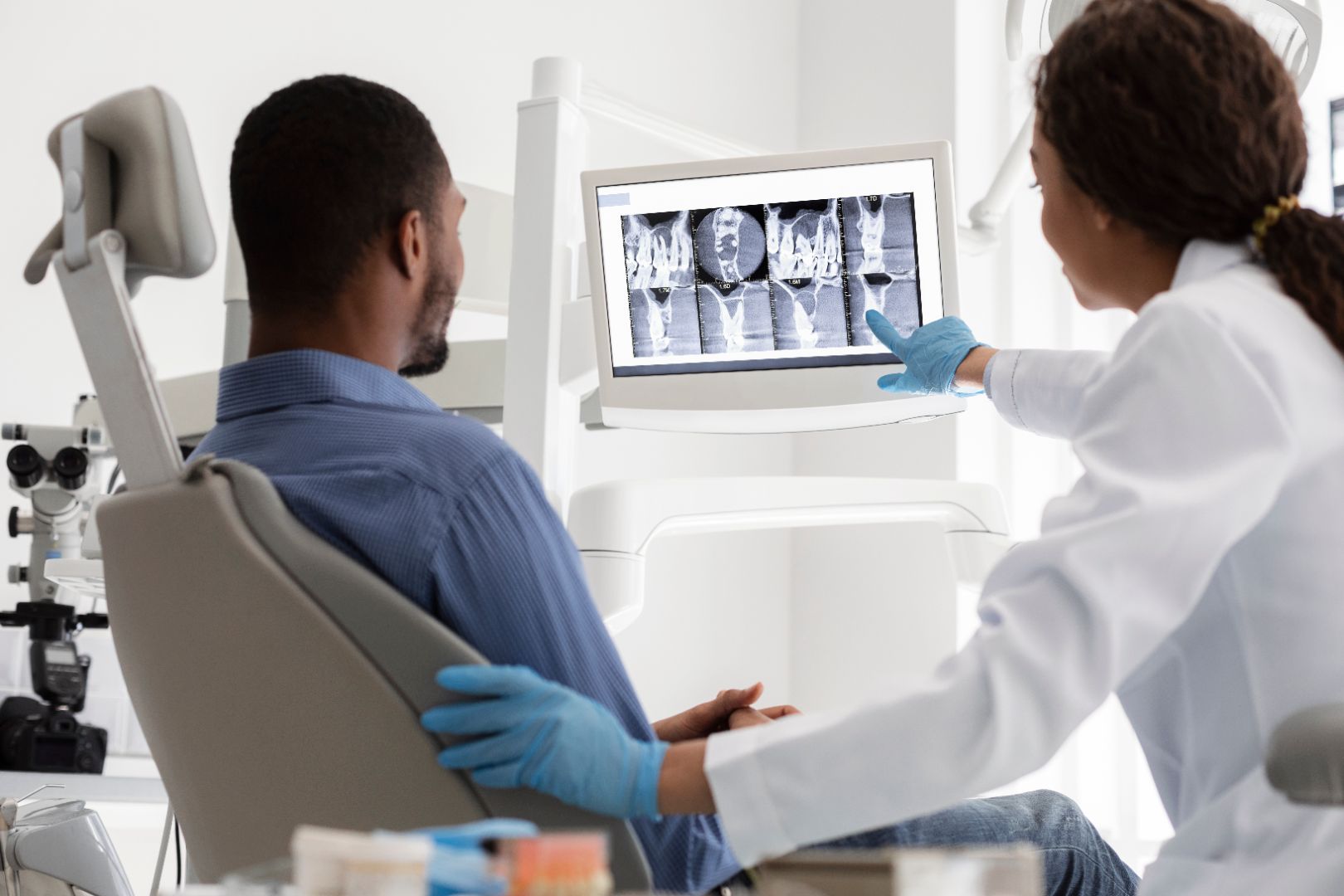
Ask what imaging will be used for planning — a 3D CBCT scan should be the answer, not a flat x-ray; how CBCT imaging transforms surgical planning explains why. Ask how many of these cases they do. Ask what the plan is if bone turns out to be insufficient. Ask who manages a complication, and how quickly you can be seen. And ask what the total cost covers: surgical placement, the abutment, the crown, and any grafting are separate components. Our patient resources include financial information and forms.
Talk To An Oral Surgeon In Mobile
We are glad to give you a second opinion on an implant plan, including one from another office. Call or text (251) 758-4700 or contact us. Our office is at 100 S University Blvd, Suite A in Mobile, open Monday through Thursday, 7:45 a.m. to 4:00 p.m., and Friday until 2:00 p.m., and you can read more about implant dentist in Mobile or oral surgery in Mobile, AL.